The dynamics between humans and technology are an ever-present tension in Mariana Najmanovich’s artworks. In Soft Screens, her exhibition at Gallery Aninat, the Argentinian-born Chilean artist employs artificial intelligence and synthetic skin to expand on an artistic statement that exposes the ruthlessness and realism of science fiction (and non-fiction) in the present.
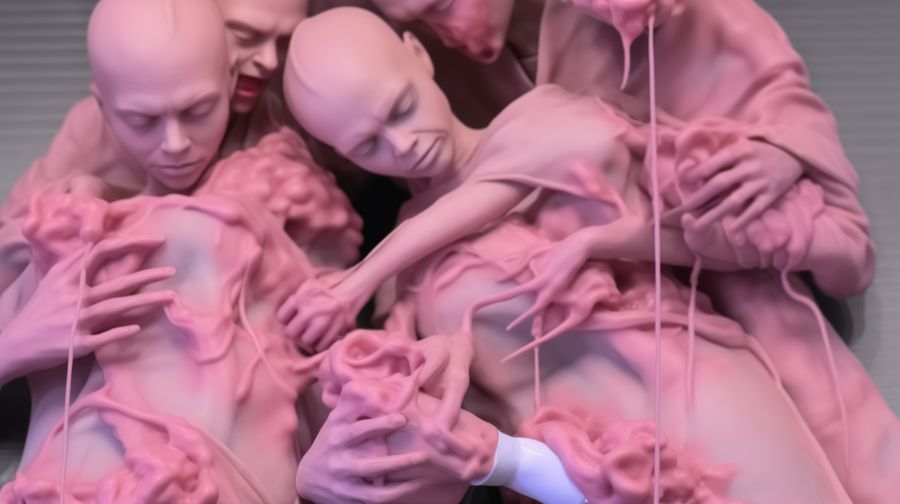
I must have seen the video at least four times in a row, unable to part my gaze from it. I was afraid of missing even the smallest fragment of that apparently incoherent and shapeshifting narrative. An amorphous orgy of rosaceous beings desperately caressing each other. Unrecognizable bodies sliding across the screen, merging together into a single gooey tissue. Suggested hands holding on to the closest surface, deeply anxious to consume what surrounds them. Driven by sexual desire or an eagerness to survive. The fragments that fail to exterminate what surrounds them simply vanish.
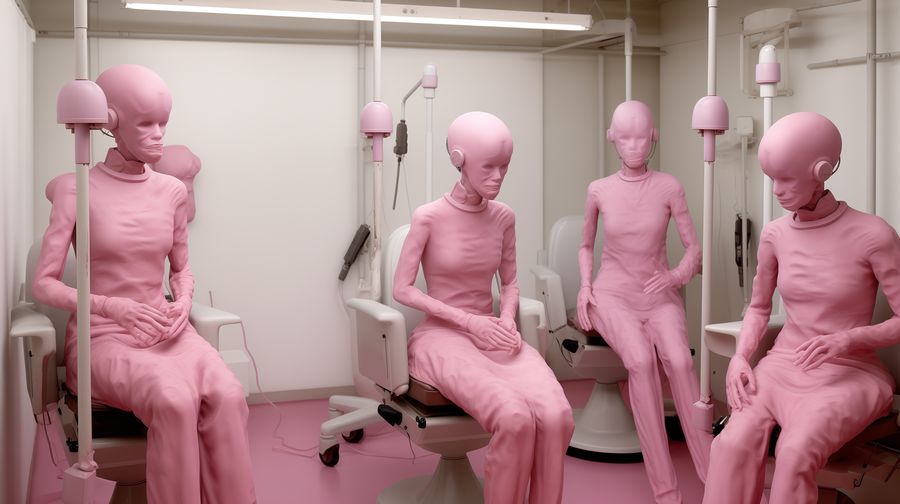
A following sequence of skeletal bodies gives way to the stillness of what appears to be a waiting room, where five anthropomorphous bodies await an unexpected moment that never comes. The confusion deepens with the emergence of an industrial assembly line inside a factory-like ambiance inhabited by deformed entities, whose numbers vary frequently. Both they and what they produce, as well as the surrounding architecture, change shape incessantly, strategically configuring a sort of glitch, which continuous flow does not soften its magnetism.
Produced in collaboration with the art collective Hyperikon, Liquid Biology is one of the 16 artworks composing the Soft Screens exhibition. Amidst the encounter with these pieces, Aninat Gallery’s main room transforms into a non-place, located in between reality and desire, life and death, imperfection and flawlessness. In other words, between human and post-human. Within this environment, visitors become aware, at least for a moment, of the liminal space in which Najmanovich’s characters find themselves. Disturbing avatars that embody our present.
TAILOR-MADE BODIES
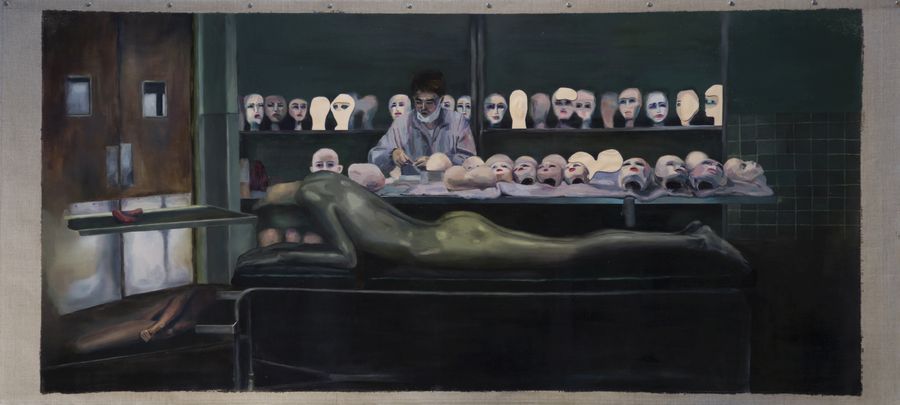
In New Substances XII a woman’s body lies face down on top of a stretcher. Behind her, a man performs an indecipherable procedure on a plastic face. In the background of the painting, a series of heads of varying sizes, with seductive eyes and tempting lips, are arranged lifelessly on two shelves, awaiting to be assembled into the body that best suits the client’s expectations.
The painting may seem like a science fiction scene. However, in reality, it vividly depicts the everyday life of a factory related to a global market that has ascended to 411 million dollars. In a 2016 article by the BBC, Real Doll’s creator declared his business had a positive impact, since it provided real happiness to its customers. He explains that his dolls are not purely sexual, since they also may fulfill a companion role for those who purchase them.
The enterprise seems to brag about distancing itself from the sexualization of women, emphasizing the emotional dimensions in the acquisition of one of its dolls. However, it completely dismisses the ethical dilemmas its business arouses, prioritizing happiness even at the expense of delusional sentiment.
A similar reflection is prompted by the screens in the Skin Cabinet. The collage series depicts cellphones embedded in rosy silicon skin projecting smiling selfies that mimic an Instagram feed. The cold screens interrupt the tactile warmth of human skin, insinuating their profound integration into our daily lives, almost as a part of our bodies. Simply leaving our houses without our cell phones, a dependence phenomenon that characterizes our times, makes us feel as incomplete as if being fully naked.
The construction of identity propelled by social media does not limit itself to the technological realm. Body modification attainable by plastic surgery, though less common than digital personalization, is equally substantial. According to the last global survey conducted by the International Society of Aesthetic Plastic Surgery (ISAPS), cosmetic surgeries reached a total of almost 35 million (ISAPS, 2023).
This reality is vividly portrayed in New Substances XII canvas. At the center of the image, we see a woman with an immaculate skin mask that hides her natural features. The artwork was created in 2021, coinciding with the year in which the American Academy of Facial Plastic and Reconstructive Surgery, (AAFPRS) published a survey in which 79% of the participants cited the “Zoom effect” as one of their motivations for undergoing a face procedure (AAFPRS, 2023). A term referring to the forced increase in digital meetings during the pandemic, which lead people to spend more time scrutinizing their own appearance, thereby serving as a pretext to identify at least one perceived flaw that they could improve.
CARNAL SPECTACLES
The installation that unfolds within one of the gallery’s walls evokes a previous work by Najmanovich, showcased in 2019 in Museo Nacional de Bellas Artes. Both artworks refer to the bed as a concept, but while Other Genesis takes the shape of a mattress with quotes belonging to the book El desierto y su semilla (The Desert and its Seed) tattooed in red ink, Soft Screens II mimics an extended bed cover, with oil-painted scenes across its surface. These images are inspired by the visual representations generated by an AI program in response to Mariana’s prompts.
In this sense, images could be interpreted as visual text, mediated by an almost human filter that deepens their ominous nature. This quality intensifies with each modification process applied by the artist, who employs a collage-like approach to image manipulation, combining digital layers using Photoshop with physical layers created with paint.
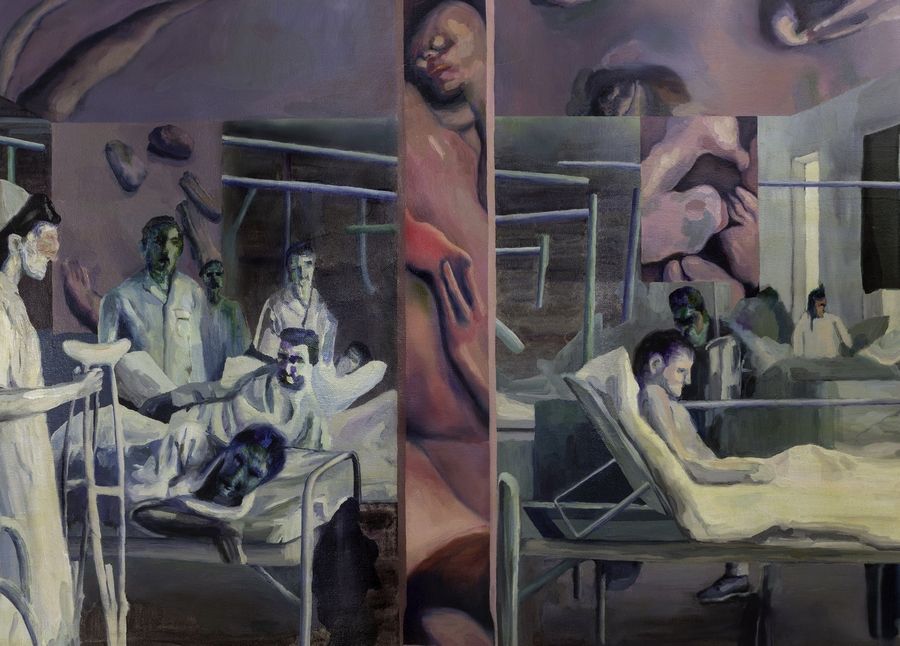
In Soft Screens II, images are concentrated on the upper half of the mattress and arranged in a triptych-like manner. They depict a background interrupted by a painted stripe, with the central panel seemingly showcasing Liquid Biology’s opening scene, serving as a peephole into the video’s amorphous orgy. Surrounding this central depiction are images evoking the clinical environment prevalent throughout the film: languid bodies resting atop stretchers, surrounded by doctors. Amidst this clinical backdrop, the central image encapsulates human sexuality’s intrinsic vitality, starkly contrasting with the mortiferous atmosphere in which it is embedded.
The structure of the artwork relies on polymer modules that serve as synthetic skin. Its surface contains protruding eyes and mouths, resembling silicone masks used for practicing makeup techniques. Despite its realistic appearance an unsettling quality pervades, as is often the case with the rest of Najmanovich’s artistic production. The rosy-colored skin and flawless texture are more reminiscent of a Barbie doll than a human being.
Synthetic skin modules are also integral components of Soft Screens and Soft Screens II, both suspended mid-air with braided cotton ropes. These intricate fastenings were meticulously crafted by a shibari expert, who mastered the Japanese art form of rope binding. While some may draw comparisons to Western bondage, shibari transcends mere immobilization of the body; it embodies a sophisticated aesthetic appreciated by viewers and offers a unique sensory experience for the bound individual.
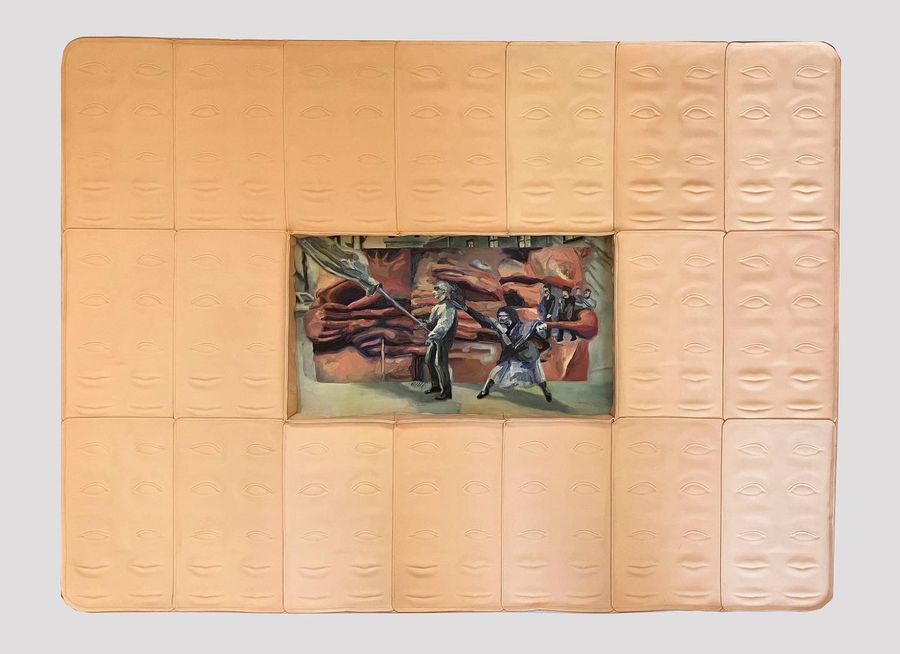
The sexual drive inherent in shibari practice finds resonance in the bed representation of Soft Screens. The rectangular shape and stuffed appearance of the installation immediately evoke the image of a folded mattress wrapped in plastic, akin to those displayed in commercial stores. In this second bed-like installation, the imagery created with AI is based on a historical photograph depicting a woman striking a young protester with her handbag during a neo-Nazi march.
This iconic image, captured in 1985 in Sweden, encapsulates a complex duality of vulnerability. On one end, a rude young man is confronted by the forceful stroke of a vulnerable woman, while on the other, a middle-aged lady constantly enduring the trauma caused by the memory of her mother‘s experience in a concentration camp. The image portrays a reversal of vulnerability, as the seemingly powerless woman momentarily assumes a position of strength. However, her courage belies the deep-seated helplessness in the face of an unforgettable genocide. This desperate sentiment lies not only in its historical context or the enduring trauma of losing a loved one but also in its stark reminder of the persistent ideology evidenced in every neo-Nazi march.
When an image is processed through an artificial intelligence program, the machine is tasked with deciphering the emotional nuances within the scene, attempting to capture the resonance of a series of experiences it has never encountered and never will. Thus, Mariana’s operation presents a tangible impossibility, a halfway-finished process that pushes the boundaries of artificial intelligence. In this context, the resulting image can be seen as a manifestation of a mirage, encapsulating the tensions between human thought and the attempt to replicate it.
Soft Screens III features another artificial intelligence-generated image, resembling an old TV suspended between the bed-like installations. The scene recalls the ambiance of anatomy lesson paintings, a subject often depicted in art history to illustrate body dissection procedures for educational purposes. One of the most iconic artworks within this genre is Rembrandt’s The Anatomy Lesson of Dr. Nicolaes Tulp.
In the painting by the Dutch master, the renowned doctor is depicted performing a public surgery on a condemned criminal. Spectators are shown dressed in elaborate attire, suitable for such a special occasion. In Rembrandt’s era, the Amsterdam Guild of Surgeons permitted only one public dissection annually, which made the event widely perceived as an exciting spectacle. In fact, the high demand for attendance allowed for admission charges (Rachlin, 2007).
One of the nurses present during the medical procedure gestures towards what appears to be the torso of the humanoid criminal creature, as if tracing the path to be followed by the scalpel with her finger. Eleven other nurses surround the main subject, their facial expressions barely recognizable, but their bodies leaning forward reveal their eagerness to observe the condemned being’s misery, with its limbs spread out on top of the stretcher.
Unlike the other soft screens, the synthetic skin covering this installation lacks protruding lips and instead only features pairs of eyes, possibly symbolizing the numerous imaginary spectators observing the spectacle alongside the nurses.
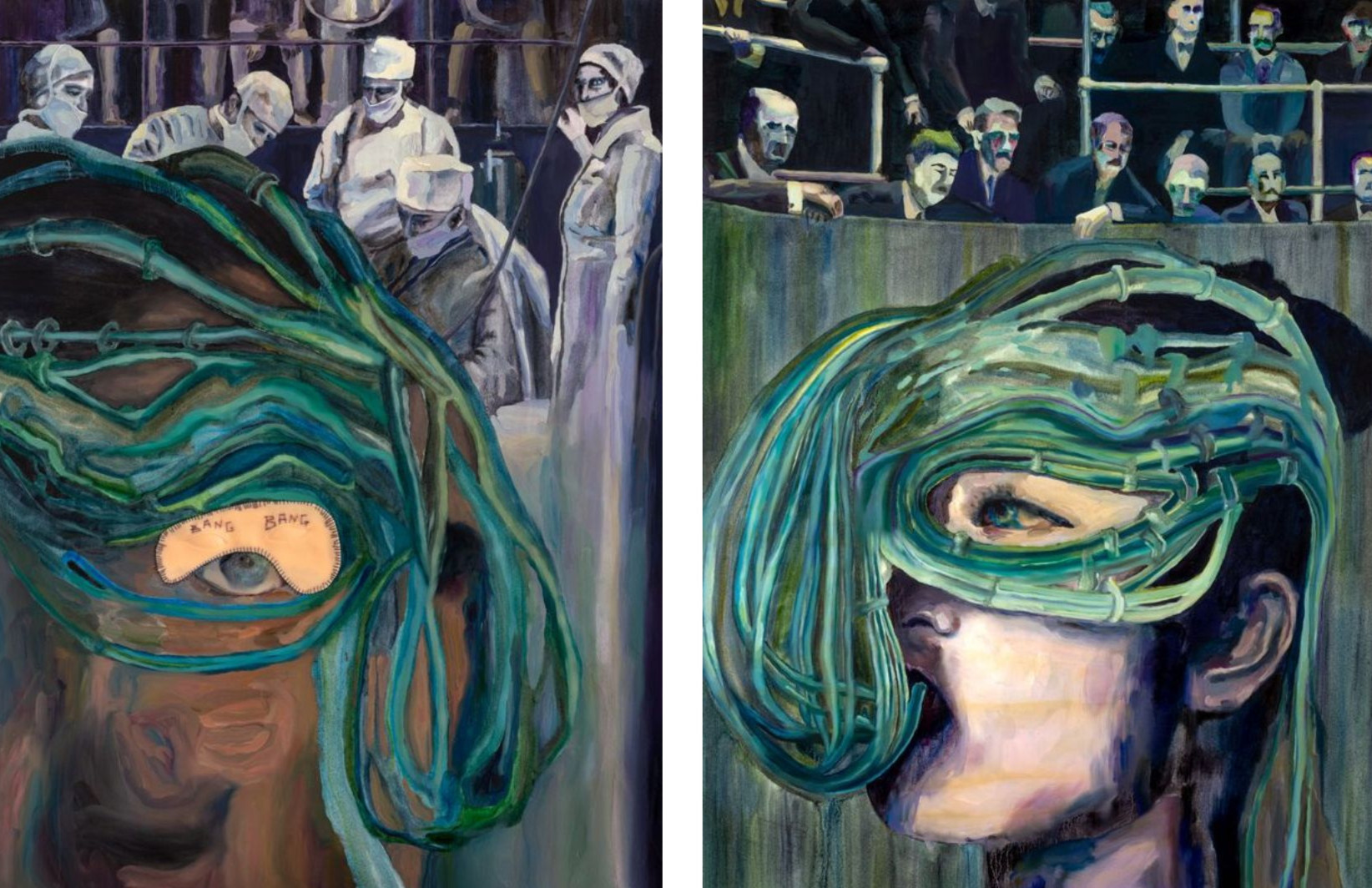
The morbid impulse resurfaces in Utopia I and Utopia II, transporting viewers to what could be interpreted as a modern colosseum, unveiling a captivating yet unsettling scene. In each painting, an individual is portrayed ensnared by tangled cables, the final purpose of the procedure remaining unclear though its violence is undeniable. It appears to depict an unknown torture method; beyond its utilitarian objective, the procedure evidently implies the subject’s submission.
By the bleachers, an undisturbed audience witnesses the scene. In Utopia II, the scene is obscured, as the frame cuts to the level of a group of doctors performing a procedure in the background. In contrast, in Utopia I, we catch sight of eleven men, seemingly belonging to the aristocracy, devouring the victim’s disgrace with their eyes. Both paintings encapsulate the message within this startling exhibition: the impossibility of dissociating the unethical implications of technological developments from the socioeconomic system that endorses them.
Original article in Spanish in https://artishockrevista.com/2024/03/16/devorando-miserias-con-los-ojos/
Devouring Hardships
https://artishockrevista.com/2024/03/16/devorando-miserias-con-los-ojos/
Periodista cultural