All I knew was that I was going to experience witchcraft. It wasn’t a historical presentation on spells and black cats, nor a modern take, like a Wiccan circle. I had spoken with one of the curators and learned that his proposal aimed to connect video animation with magic, featuring 11 videos alongside the props used in their creation. Their dynamic would reveal the magic within animation, infusing each object with vitality. I had chatted with Cristóbal a few times to learn more about his film projects, a creative field in which he has gained wide recognition along with his artistic partner, Joaquín Cociña.
Their 2019 animation, La Casa Lobo, has made a huge impact—not only as Chile’s first full-length stop-motion film, but also for its wildly uncanny style. As the story progresses, papier-mâché characters constantly disintegrate, and manually applied black paint oozes down real-scale room walls. The movie is so unsettling that a friend of mine couldn’t fall after watching it. Her experience seemed particularly significant, considering she studied both physiology and literature and therefore should be accustomed to unusual mind imagery.That was, in fact, why I hadn’t had the nerve to watch the animation until a couple of weeks before attending the exhibition. I felt I couldn’t decline a personal invitation from one of the filmmakers, but neither could I show up without having seen their most famous movie. I knew I probably wouldn’t have a chance to discuss the project with Cristóbal, as the opening event was sure to be crowded. And I was right: the rooms were so packed with people that I considered leaving and coming back another day, when I’d actually be able to see the screenings. To be honest, I’ve never enjoyed openings anyway—they tend to focus too much on socializing and too little on the art itself. Just as I was about to head home, the doors to the exhibition space opened. Standing by the entrance, I suddenly found my path blocked by a crowd of eager spectators, pushing me inside the room.
As I was swept into the room, an unexpected hush fell over the crowd, amplifying the indistinct murmur that filled the space. A large video projection emitted the clearest audio—a succession of eerie, vibrational sounds. On the screen, a piece of orange plasticine pulsated into shifting geometric shapes, its colors changing rhythmically. Suddenly, a sketched 2D face appeared on its surface, alternating with the image of a clay-modeled human head. whose eyes popped open, gasping in a death rattle-like sound. The images in the video kept changing constantly, adopting the shapes of multiple characters. Among them, I perceived what appeared to be an articulated wooden stringless puppet and a beheaded reptile. Somos monstruos, by Trinidad Santibañez. functioned like a ten-step exorcism, with each phase taking the form of an inner execration.
My phone vibrated in my pocket, snapping me back to my surroundings, where everyone seemed absorbed in the movie. They appeared to be holding their breath; the silence heightening the bizarre gagging of the towel worm on screen. Suddenly I realized I was witnessing pure magic: a group of silent people, captivated by the artwork, during the exhibition’s opening.
As I lifted my head, I noticed the couple next to me engrossed in the adjacent wall. That’s when I remembered there was a projection on its surface—a circular display where a kaleidoscopic world unfolded. A black-and-white, ghostly surface throbbed rhythmically, first revealing and then engulfing surrealist visions. Suddenly, the shape of a face emerged, its head filling the entire circle. The forehead was split open, with droplets striking a vacant skull—flat like a pond. It felt as though we were drawn into the fantasies of an absent-minded creature.
When the movie ended, I moved into the next room. With its main wall surrounded by a display case, the space evoked a cabinet of curiosities. Underneath the screen, which played the animation, lay six headsets, each one belonging to the protagonist of Hugo Covarrubias’ Bestia. I had seen this movie a couple of years ago, back when it was nominated for an Oscar. It probed into Ingrid Olderock’s mind, a torturer who collaborated with Pinochet’s regime during the Chilean dictatorship during the 70s and 80s.
The film opens and closes with the same scene of the woman on a plane, staring out the window. Confronted by the haunting memory of her victims, Ingrid gazes in detachment as she lights a cigarette. Her indifferent reaction underscores the impunity with which she lived, right up until her death from gastrointestinal bleeding at the age of 57.
In the showcase, the six headsets were surrounded by various props from the video. To their left, a wooden shelf displayed military trophies, while a storage cabinet beside it housed kitchen items. This juxtaposition of military honors and everyday domesticity vividly portrays her complex character, suggesting a bellicosity lurking beneath the surface of her seemingly ordinary life. Directly beneath the left corner headset was Ingrid’s ceramic doll, resting on a green grass carpet, with her dog by her side. The felt puppet, a reproduction of her German Shepherd trained to assault Ingrid’s victims, possessed an unsettling charm that appeared to conceal a pulsating evil.
It made me think of a creepy take on Walter Benjamin’s aura, as if the figure were actually possessed by historical violence. Noticing the growing crowd around me, I decided to move on and explore a series of shelves ahead. Eight of them appeared inhabited by the dolls used in the exorcism depicted on the screen in the first room. The dolls from the video seemed to infuse the others, creating a shared energy among them. They all appeared bound by a mysterious dimension—an authentic essence that rendered them both unsettling and fragile.
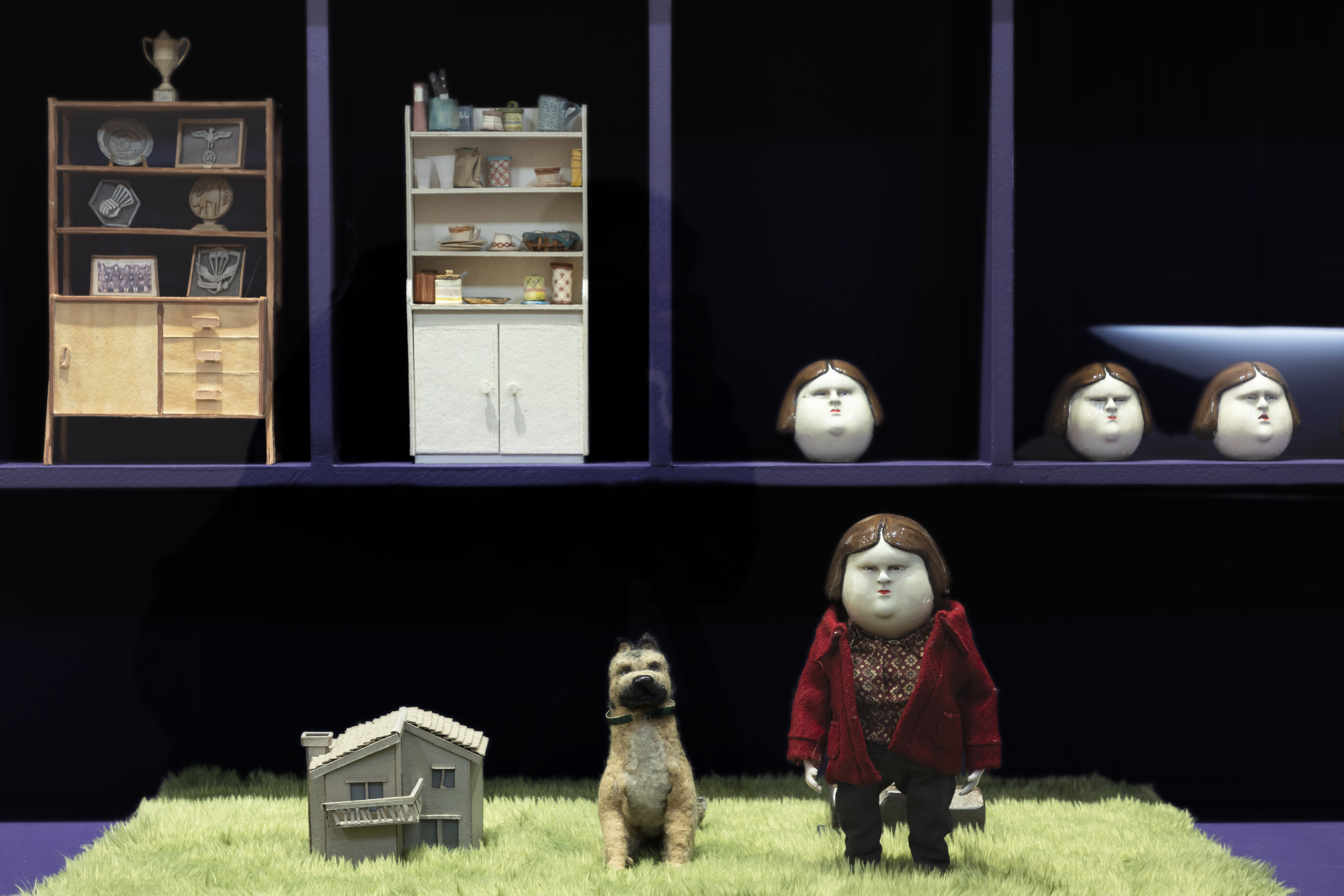
This Benjaminian dynamic highlighted the entire concept of witchcraft, as the objects took on the remnants of a magical ritual. The video repeated the ceremony, transmitting energy in a continuous flow. Within this scenario, the pieces blended ritualistic and exhibition value, with each dimension enhancing the other.
Beneath the group of exorcism dolls, I noticed that the bonding dynamic extended into two-dimensional objects. Still frames from a kissing scene immobilized a video through the brushstrokes of a series of oil paintings. The images were arranged in five stacks of three frames each, all captioned and numbered, creating a total of 15 depictions. This represented only a small portion of the 432 still frames that inhabited the video, extending the imagery of the flame, the lovers, and their union into an endless expanse of space and time. The video bonding’s ongoing nature was evoked through the noise of a lighter’s ignition which looped itself constantly. It was the sound that sparked this fiery love ritual, binding the couple together within the video’s eternal space.
The candle illuminated the entire ambience of the showcase, radiating its light onto the animated pages of a nearby book. This illustrated tome, titled La caza del Zorro, featured a pop up interpretation of Uccello’s painting, The Hunt in the Forest. The corresponding screen displayed a video animation that digitized the pop-up book’s drawings, presenting them through frame-by-frame illustrations. The result was a hypnotic surrealist sequence in which the initial fox from the painting transformed into a man on the moon and a corpse falling into a nighttime pool. The video was silent, with its images infused by the barks of Bestia’s dog and the repetitive sound of the love spell lighter, merging into one.
As I was about to continue my journey around the shelves, I discovered there was no more room left. What had seemed like a special extension, revealed itself as a bathroom when I tried to open the door at the end of the hallway. I couldn’t believe there was nothing behind the wall, so I even entered the room, pushing myself to understand that no trick was being played. My eyes wandered across the upper edges of the shelves, stumbling upon the speakers that brought life to a machinery room. It was right where the Wizard of Oz would have been, had we attended the musical film’s production.
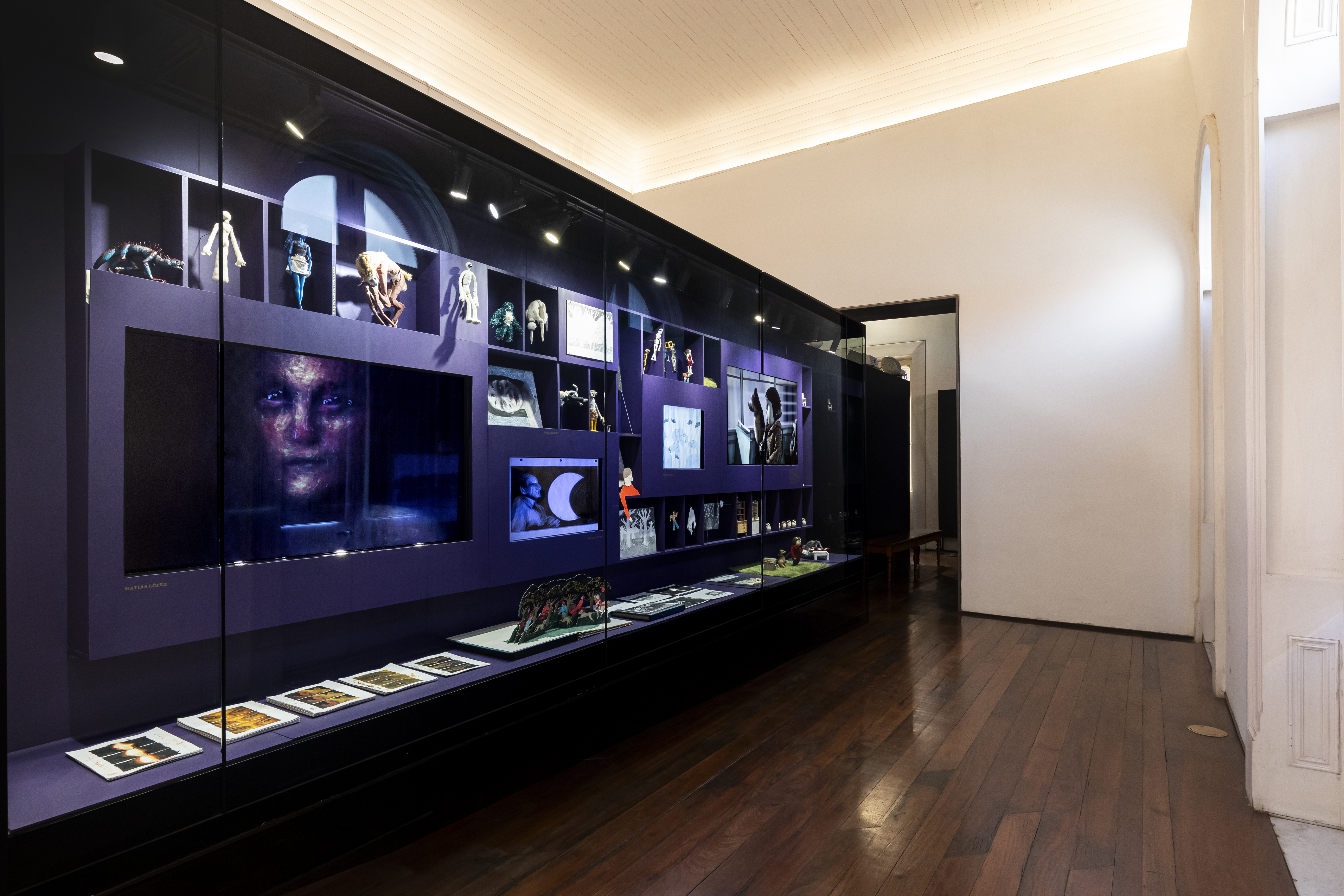
As I was about to leave the building, I noticed the exhibition extended into the room next to mine. However, when I entered, I found this space even more crowded than the first, so I decided to leave and return another time. Still, I couldn’t resist peeking inside for a moment and found the dress and mask of Constanza Nordenflycht, the protagonist from Los Huesos by León and Cociña. The character depicted by these props had been a 15-year-old girl who became famous for being courted by ex-state minister Diego Portales, an 18th century statesman and a key figure in the consolidation of Chile’s constitutional republic and its authoritarian overtones. In the short film, Constanza performs a ritual to revive Portales, along with Jaime Guzmán, another politician blamed for exacerbating the deficiencies in the legal framework.
I sensed their necromantic obsession in the exhibition’s design, with the cabinet shelves resembling a series of niches. The space felt like a mausoleum, holding corpses poised to come to life through magical incantations. This idea became even more vivid with a severed head resting on one shelf and an arm dangling from another. Each extremity belonged to a different body: the arm was from *Los Huesos¨ and the head from Los Hiperbóreos. That was a reference I wouldn’t get, because it hadn’t premiered by then. That still wouldn’t explain why the curators had decided to omit a monitor displaying Los Huesos, though. I assumed it had to do with the probability of it being already widely known and wrote a mental note to ask the curators about it.
The head and arm within the shelves were linked by a series of paintings featuring mysterious organic forms. I noticed a connection to the video in the previous room, where similar skeletal shapes appeared. A visitor nearby mentioned that the artworks were by someone she referred to as Kokó, sparking my journalistic curiosity. When I asked for more information, the visitor offered to introduce me to the artist. She led me to the entry hall, where I encountered a young woman with a rebellious style. Dressed in a long black dress and a velvet olive-colored jacket, she looked like a fairy sorcerer herself. As soon as we started talking, I became engrossed in the conversation, asking Kokó questions about her artistic work and its connection to magic and nature. At one point, a young man interrupted to ask if she wanted to join him and his friends for a drink. Kokó introduced me as a journalist and him as the creator of the kiss animation, after which he extended the invitation to me as well. Though I had to head back to work and politely declined, I was already set to return another day.
When coming back again a few things would be different: fewer people would stand between me and the artworks, and I’d gain more insight into the realms of magic and animation. I also explored both artists’ (Kokó Acevedo and Matías López) Instagram profiles, which I followed as soon as I left Palacio Pereira.
When I returned to the exhibition, I decided to enter through the second room. A peaceful, soothing melody drew me inside, pulling me toward its origin. I couldn’t quite describe what the music made me feel—but I’d consider it supernatural, as if it came from a different dimension. I felt my spirit lift floating in space within the airy melody. Intrigued, I followed the sound to a 65-inch screen, and the trance it had put me in deepened. Strange, ethereal images unfolded before my eyes, opening up an impossible universe. Comic visions of colorful clouds emerged within a prism, seemingly confronting an amorphous being. Its shapeshifting body was crowned with a serene, pious face, one that seemed to belong to the Virgin Mary. Resembling a dual-faced Hindu deity, the figure emitted a double-toned rosy glow. The sequence continued as the image fragmented kaleidoscopically, while a robotic female voice emerged from the prism, urging the figure to return to the world, reborn. I lingered in front of the screen, hoping to catch the video from the start.
It commenced with the prism sliding through the screen, its structure moved by a series of ropes. The figure seemed to possess some type of artificial intelligence, which somehow made it able to perceive the past and the future. When she referred to her interlocutor, she described an apocalyptic narrative, her voice accompanied by cosmic imagery and clips documenting the earth’s destruction.
After a few minutes, I realized the video had returned to the point where I had first started watching. The kaleidoscopic images merged with bluish visuals, the result of Niles Atallah’s celluloid film experimentation process. Having already worked with buried material, VITANUOVA’s celluloids were submerged under ocean water. The sequence was abruptly interrupted by a white sheet of paper with blue ink scrawled across the surface. It read the video title in handwritten letters. Against the stark white background, the sight of the word was nearly overwhelming.
As I blinked a few times, I became aware of the virgin- face doll beside the screen. It looked incredibly magical, as though the aura projected by its body in the movie lingered in that space. Though the figure remained still, my mind was left with the sensation of pulsating movement, as if the stillness I perceived were merely an illusion.
Something similar happened with a nearby projection, which depicted the story of a house’s destruction. In the animation, by Emilia Maulén, a pink-coated building gradually crumbled, as if an earthquake had split it in two and swallowed it whole. I became almost addicted to this process of disintegration, sensing a hypnotic violence pulsating within it. As might be expected, there were no traces of the pink house on display as part of the show. Yet, the artist’s work was still present, in the form of two model rooms exhibited in one of the showcases. Created through the use of recycled material and showing themselves partially destroyed, the doll-sized rooms appeared as if they had once belonged inside the main house—like decaying remnants of a soul that had already died.
It made me think of what I’ve read in the Greek Magical Papyri (PGM) when searching for more information on ancient magic. PGM refers to a group of written documents dating from the 100s BCE to the 400s CE, which included a variety of magical rituals. These would serve the most different purposes from curing a headache to binding lovers, seeking protection, or revealing hidden truths.
Many of the procedures involved a magical artifact— an object believed to serve as a fate changer for the practitioner. Though described in ancient papyri, most of these artifacts were lost over time. Often, they were destroyed during rituals or crafted from organic materials like papyrus and leaves. In many cases, practitioners preferred these materials over rarer ones, such as gold or stone, especially when the spell allowed for alternatives. For instance, love rituals might involve a diverse range of materials, including wax, the subject’s hair, and animal blood. Some rituals also utilized fire, coinciding with López’ Amarre (Love binding) video.
This connection between the artworks and magic permeated the entire exhibition, as the practice of animation shares the same flexibility as magic. With León and Cociña’s work in mind, I expected most of the videos to use stop motion, so I was surprised to find that this wasn’t the primary technique. For instance, Paula Dittborn’s La Caza del Zorro was created using analogue frame-by-frame animation.
Using the exhibited pop-up book as a reference, the artist created a series of 2D illustrations, which she later animated. Dittborn’s project felt especially magical, as pop-up books have a historical connection to magic. Now largely seen as playful, child-oriented books, these movable creations originally emerged for scientific purposes. Many featured a mechanism called a volvelle, which consisted of a rotatable paper device.
By the year 1200, the Catalan mystic Ramon Llull was using volvelles in his Ars Magna, developing a logical framework that connected divine attributes and aimed to reveal universal truths. These rotating paper devices illustrated relationships between theological principles, serving as early examples of combinatorial thinking. Llull’s innovation would influence both mystical and logical studies in centuries to come.
In Dittborn’s video, the pop-up book scene is followed by rotoscoping, another type of frame-by-frame animation in which the artist traces over pre-existing footage. These include scenes from L’hypothèse du tableau volé and Sunset Boulevard. Matias López also used rotoscoping in Amarre, but his source material was more varied, incorporating family footage and Archive.org found videos. In his previous works, López primarily used this technique to modify memes, oil-painting over frames from Chilean viral YouTube videos.
Kokó’s profile offered deep insight into her artistic background, revealing her tendency to work with self-made paintings. In line with León and Cociña’s aesthetics, she often preferred recycled materials, lending her work an intentionally unfinished quality. Her pieces emphasized the imperfections of the production process, with rough edges and a focus on the manual aspects of creation. This made it all the more surprising that she was one of the two artists presenting a digital animation. Within the video, the drawings’ unmistakably handcrafted style makes the digital technique almost imperceptible.
In front of Esferas found myself pondering once again upon the dynamics of the aura. It appeared to me as if Kokó had performed a different type of magic, occurring when she transferred her artworks into the digital medium. The thought led me to conceive an expanded version of the concept, as a take that would engulf both representation and represented subject. Upon this dynamic, the highest artistic ritual value would live within a larger interaction involving the entranced spectator. This interplay originated a realm where suspended disbelief didn’t lessen the impression of the new logic of space and time.
Though I was satisfied with my interpretation, I later learned that the decision to use Kokó’s digital video had been a practical one, based on the availability of technical equipment. The same reason explained why the curators chose not to include any of their own videos, prioritizing the work of others instead. Ironically, this absence only made the audience’s role feel more active, as if we had become part of their sorcery rite.
I came to see the art show itself as a permanent and collective ritual of magic, weaving together heterogeneous spells. The exhibition seemed to operate like a Russian doll, with one conjuration inside the other, producing waves of expansive witchcraft. Within this parallel reality, León and Cociña acted as the conductors of a magical experience as diverse as magic itself.
Participating Artists: Hugo Covarrubias, Marcos Sánchez, Cristóbal Cea, Niles Atallah, Trinidad Santibáñez, Esteban Pérez, León & Cociña, Matías Bárquez, Matías López, Emilia Maulén, Paula Dittborn y Kokó Acevedo González.
Periodista cultural